


Nonocross
3.292.00 Reviews
App Specs
- Version
- 1.1.0
- Updated On
- License
- Free
- Downloads
- 100,000+
- Developer
- Gimica GmbH
- Categories
- Puzzle
- Platform
- Android
Screenshots
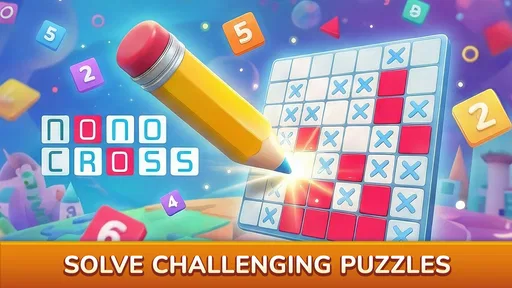
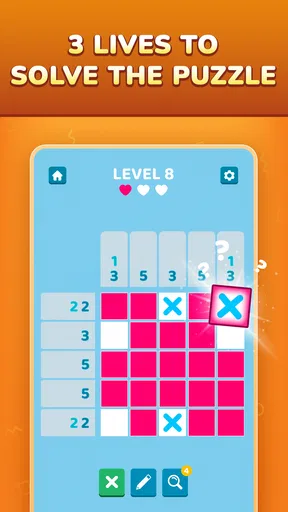

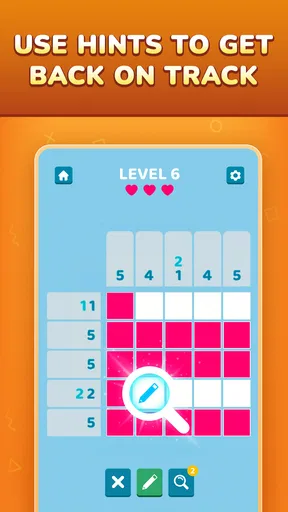
 Analysis by AppCompare
I spent time with Nonocross as a compact puzzle game built around Nonogram logic and pixel-art reveals. The basic idea is easy to understand: read the number clues around a grid, fill the correct squares, and gradually uncover an image. That familiar format makes it approachable, but the real question is whether the game gives me enough reason to keep solving one board after another.
My overall impression is positive but measured. The puzzles are a good fit for short breaks, quiet evenings, and anyone who enjoys deduction more than fast reflexes. At the same time, the experience depends heavily on how much variety and challenge you expect from a Nonogram game. It is free, aimed at Everyone, and developed by Gimica GmbH, so it has the broad accessibility I would want from a casual logic title. Its average rating is 3.2 from around 400 ratings, which also suggests that the experience will not suit every player equally.
How the early goals turn a simple grid into a reason to continue
The first few puzzles are about learning to trust the clues rather than guessing from the picture. Each row and column gives you a small logic problem: a number tells you how many consecutive cells belong to a group, while spaces between groups matter just as much as the filled squares. When I approach a board carefully, every certain mark creates another piece of information somewhere else, and that chain reaction is the satisfying part of the game.
That early learning curve works because the objective is visible from the start. I am not trying to master complicated controls or understand a large collection of menus. I am trying to complete the grid and see what image is hidden inside it. The pixel-art reveal gives each solved puzzle a clear finish line, which is more motivating than completing an abstract arrangement with no visual payoff.
For a newcomer, I recommend beginning with a deliberate routine instead of tapping quickly. I scan for rows or columns where the clues leave very little room, mark the cells that must be filled, and then use the empty spaces to separate groups. This approach reduces accidental guesses and makes the logic easier to follow. It also helps me notice whether a puzzle is genuinely solvable from the clues or whether I am rushing because I want to see the final picture.
The hidden image is a useful reward, but it should not be mistaken for the entire progression system. The strongest reason to continue is still the solving process itself. If you enjoy deduction, the reveal adds a pleasant sense of completion. If you mainly want a collection of attractive pixel pictures, the logic work may feel like a barrier between you and the reward.
One practical use case is a short commute or a waiting-room break. Nonograms are naturally easy to pause mentally because each row and column can be treated as a separate problem. I can make progress without needing a long uninterrupted session, then return later and reassess the uncertain parts. That makes this a better companion for fragmented time than puzzle games that require memorizing a large state or reacting continuously.
Worth Reading Before You Choose

Flipboard Shows What News Apps Must Do Beyond the Feed

Switching to Android Auto Means Rethinking Your Driving Routine

Google Calendar Makes a Crowded Week Easier to Manage

Ludo King Makes the Most of the Minutes Between Plans

Baby Panda World Brings Quick Play to Modern Phones, but Its Game Library Feels Busy

ESPN’s Live Game View Makes Following Close Games Easier
What progress feels like while solving
Nonocross communicates progress primarily through the board itself. Filled cells, cleared spaces, and the gradually emerging artwork provide immediate visual feedback. I do not need a separate explanation to understand whether I am moving forward: a correct deduction visibly reduces the remaining uncertainty.
That simplicity is both a strength and a limitation. It keeps attention on the puzzle instead of surrounding systems, but it can also make progression feel quiet. Players who expect elaborate unlock trees, character development, daily objectives, or a strong collection layer may find the experience modest. The verified store information presents it as a Nonogram puzzle game, and that is the right way to approach it: the board is the main event, not a broader adventure wrapped around it.
I found that the best progress signal is not merely the percentage of the grid completed. It is the moment when a previously unclear line becomes forced because another line has been solved. Those small breakthroughs create a rhythm: inspect, mark, cross-check, and inspect again. A useful habit is to revisit every row after completing a column. Players often focus on the newest deduction and overlook how it changes an older clue.
Another helpful technique is to separate certainty from possibility. I treat filled cells as confirmed, empty cells as confirmed spaces, and untouched cells as unresolved rather than secretly belonging to one group. This prevents the common Nonogram mistake of turning a plausible pattern into an unearned assumption. On larger or more demanding boards, that discipline matters more than speed.
The pixel-art result also gives the game a visual identity that plain number-grid alternatives may lack. In a traditional Nonogram app, finishing can feel like checking off a logic exercise. Here, the emerging image gives me a reason to look at the board as a whole. The trade-off is that the artwork can influence my judgment: once I think I recognize a shape, I may be tempted to force the clues to match it. I had better let the numbers lead and use the image only as a reward.
Difficulty, pacing, and the point where patience matters
The difficulty of any Nonogram comes from the relationship between clue patterns and available deductions. Straightforward lines can provide an immediate entry point, while mixed groups require more careful spacing. A puzzle feels fair when I can explain why each move follows from the clues. It feels frustrating when progress depends on guessing, especially because one incorrect mark can distort the rest of the grid.
Nonocross is most appealing to players who enjoy that gradual increase in mental pressure. The game does not need fast action to create tension. A nearly completed board can be more stressful than an empty one because every uncertain cell matters. I like that kind of pressure when I have the time to check my reasoning, but it is less enjoyable when I am looking for a completely effortless distraction.
My advice is to slow down as soon as a puzzle stops offering obvious moves. Instead of scanning the entire board repeatedly, choose one clue group and calculate its possible positions. Mark the cells shared by all those positions, then use the known gaps to restrict neighboring groups. This is a more reliable workflow than tapping around in search of a lucky opening, and it turns a stalled board into a structured problem.
Players who already solve Nonograms regularly should adjust their expectations. The appeal here is not that it reinvents the format. Its value is in presenting the familiar logic in a compact, visually rewarding package. If you want advanced puzzle construction, extensive customization, or a highly competitive environment, a more specialized Nonogram alternative may be a better choice. If you want an accessible way to return to the format, this game is easier to recommend.
The pacing also depends on the size and complexity of the board in front of you. A quick puzzle can fit between other tasks, while a more involved one asks for sustained concentration. I would not start a difficult grid immediately before something important, because stopping halfway through can leave me mentally carrying unresolved clue relationships. For a calmer session, I prefer beginning when I can give the puzzle enough attention to finish or reach a clean stopping point.
Does the reward structure sustain long-term play?
The central retention loop is clear: solve a puzzle, reveal pixel art, and move on to another challenge. That is enough for people who already like Nonograms, but it may not create the same pull for players who need frequent external rewards. The game’s strength is its self-contained logic loop, not a promise of a large progression framework.
That distinction matters when deciding whether to install it. Someone who enjoys the feeling of improving their deduction skills can find lasting value in repeated boards. Someone who needs new mechanics, story developments, or substantial changes from one session to the next may run out of motivation sooner. I would describe the retention pressure as gentle rather than aggressive: the game invites another puzzle, but the puzzle itself has to earn that next tap.
The free price lowers the barrier to trying it, and the Everyone age rating makes it suitable for a broad audience. It is also available for devices running Android 7.0 or later, which covers older Android hardware that cannot handle many newer games comfortably. That does not automatically make every device experience identical, but it does make the game relevant to people looking for a lightweight puzzle option rather than a demanding visual production.
One everyday scenario shows where it works best. Imagine having ten minutes before an appointment. I can open a board, solve a few forced lines, and stop without losing the basic logic I have established. If I return later, the filled and cleared cells show me where I left off. That is more practical than a game whose enjoyment depends on completing a full level in one sitting.
There is also a useful mental reset in switching between certainty and uncertainty. When I feel stuck, I stop trying to solve the whole picture and ask a narrower question: which row has the fewest possible arrangements, or which column has a group that can only fit in one region? This turns the game into a small exercise in organizing information. It is a stronger long-term habit than chasing the image by intuition.
Still, the game is not the right fit for everyone. I would skip it if I dislike static grids, find number clues tedious, or want immediate action and constant audiovisual stimulation. I would also look elsewhere if I need a robust competitive ladder or a clearly documented set of advanced modes. Nonocross is best judged as a focused puzzle experience, and its focused nature can feel limited when compared with broader casual-game collections.
How it compares with familiar puzzle alternatives
Compared with a standard crossword, Nonogram solving is less dependent on vocabulary and more dependent on spatial deduction. I do not need to know a fact or find a word; I need to place groups correctly while respecting their order and separation. That makes it a better choice for players who prefer visual logic, while crossword fans may miss the language and clue-writing element.
Compared with Sudoku, the experience is more visual and more directly tied to a final image. Sudoku rewards number placement within repeated constraints, whereas a Nonogram asks me to reason about runs of filled cells across two directions. I find Nonocross more satisfying when I want a visible transformation, but Sudoku may be better for someone who prefers a cleaner, more abstract logic board.
Compared with match-three games, the pace is slower and the satisfaction arrives through certainty rather than quick combinations. There is no equivalent of a rapid chain reaction to carry a tired player through a session. In exchange, I get a puzzle that rewards attention and can be paused naturally. The choice comes down to whether I want to relax through repetition or engage through deduction.
Specialist Nonogram apps may offer a deeper toolkit for experienced solvers, depending on what the player values. A dedicated alternative can be preferable when features such as extensive puzzle organization, more granular controls, or a stronger sense of long-term challenge are priorities. Nonocross makes more sense when the hidden pixel-art result and straightforward presentation matter more than building a highly customized solving environment.
The current version is 1.1.0, and the game has passed the early discovery stage with over one hundred thousand installs. Those figures suggest that it has found an audience, but they do not replace personal fit. The average rating of 3.2 is a useful reminder to approach it with realistic expectations: it is a pleasant, focused puzzle title, not necessarily a complete replacement for every feature-rich game in the category.
My verdict on goals, challenge, and staying power
I recommend Nonocross to anyone who wants a free Nonogram game with a clear objective and a visual payoff. The early goals are understandable, the board provides honest progress feedback, and the hidden artwork gives each completed puzzle a satisfying endpoint. I especially like it for short sessions because I can work through a few deductions without needing to commit to a long play session.
Its limitations are tied to the same simplicity that makes it approachable. Players looking for elaborate unlocks, dramatic pacing, or a broad set of game systems may find the experience too narrow. The challenge is meaningful only if you enjoy careful clue analysis, and the pixel-art reveal cannot compensate for a dislike of Nonogram logic. I would also choose another app if my priority were advanced tools for expert-level solving rather than an accessible casual presentation.
For me, the strongest way to play is patiently: start with the most constrained lines, record definite empty spaces, revisit affected rows and columns, and resist using the emerging image as a shortcut. That workflow makes the game more rewarding and reduces the frustration caused by speculative moves. It also reveals whether the puzzle is genuinely holding my attention or whether I am simply chasing the next picture.
My final take is that Nonocross succeeds when treated as a focused logic break, not as a full progression-heavy game. Gimica GmbH has built its appeal around the simple pleasure of turning numerical clues into recognizable pixel art. If that loop sounds enjoyable, the free download and broad age rating make it easy to try. If you need constant novelty or a deep competitive structure, I would keep looking for a more specialized alternative.
Pros
- Relaxing nonogram puzzles suitable for short or extended play sessions.
- Clear grid design makes clues easy to follow on smaller screens.
- Progressive difficulty provides a smooth learning curve for beginners.
- Offline play lets you solve puzzles without a constant internet connection.
- Helpful hints can prevent frustration when a puzzle becomes difficult.
Cons
- Some puzzles may feel repetitive after extended play.
- Hints can reduce the challenge for experienced nonogram players.
- Small grids may be less comfortable on compact phone displays.
- Ads may interrupt gameplay in the free version.
- Advanced players may find the hardest puzzles insufficiently challenging.
FAQs for Nonocross
What is Nonocross and how does the game work?
Nonocross is a logic puzzle game based on nonograms, also known as Picross or Japanese crossword puzzles. You use the numbered clues beside each row and above each column to determine which squares should be filled. Completing the correct pattern gradually reveals a hidden image. The game is turn-based and does not depend on fast reactions, making it suitable for short sessions or longer, more focused play.
Is Nonocross suitable for beginners who have never played nonogram puzzles?
Yes. Nonocross is generally accessible to beginners because the basic rules are straightforward: numbers indicate groups of consecutive filled squares, separated by at least one empty square. New players may need a little practice to understand how clues interact across rows and columns, but solving easier boards helps build confidence before moving to larger and more demanding puzzles.
Can Nonocross be played offline without an internet connection?
Nonocross may support offline play for puzzles that are already available on the device, which is useful when traveling or when mobile data is limited. However, features such as downloading additional content, synchronizing progress, displaying advertisements, or accessing online services may require an internet connection. Availability can depend on the version of the app and the device platform.
Does Nonocross include hints, mistakes, or other assistance features?
The game is designed to help players solve puzzles through logical deduction, and versions of Nonocross may include tools such as hints, error checking, undo options, or the ability to mark cells as empty. These features can make difficult boards less frustrating, although some assistance may be limited, connected to advertising, or subject to in-app restrictions. Check the current version for exact details.
Is Nonocross free to download, and does it contain ads or in-app purchases?
Nonocross can generally be downloaded without an upfront purchase, but the free experience may include advertisements or optional in-app purchases. Depending on the release, payments may remove ads, unlock extra puzzle collections, or provide additional conveniences. Before downloading, review the store listing and purchase information carefully, especially if the game will be used by children or on a shared device.


